Friday, March 29, 2013

OHC - Moss, Lichen & Mushrooms


My son and I took a walk in a local game refuge to look for any moss, lichen, and mushrooms.  There were still large areas with snow on the ground, but around the bases of trees and along the stream banks, the sun had done its work.

The thing that amazed me about this month's challenge was the incredible diversity of species.

Here are some of our mosses (although, I think some are not true mosses, but club mosses).


It's like everyone is looking in one direction.


These look like mini ferns.

These remind me of sea anemones.

Now onto our mushroom collection.  Some of these are absolutely beautiful.


I love these.  They formed on a stump left by a beaver.
 
Some kind of slime mold.

I think this might be called Ceramic parchment.

Since it is on a coniferous tree, I am going to say it is Orange Jelly.


Some kind of puffball.  I was surprised to find it in early March.
I thought it was a fall fungus.

We also found some lichen, but the pictures were not that great.

This month, we really just spent our time looking for as many different species as we could find.  It is funny how once you start looking, you see them everywhere.  Our next step will be to work on identification.


Granby - McLean Game Refuge

It was a gorgeous day and the boys wanted to go to the park to play basketball, so I decided to take a walk in the McLean Game Refuge.

The mottled bark of the sycamore is beautiful.
I crossed the bridge from Salmon Brook Park into the refuge and turned right when I got to the blue/orange/red blazed trail.  These trails run together for a bit before first the red and then the orange trail turn off.  Each trail completes a circuit with the blue trail being the longest.  I took the blue trail today.

The trail had patches of ice and mud, but nothing too serious and those disappeared altogether once I started going uphill.  At one rock outcropping, I could see through the trees to the Barndoor Hills.  The hill on the left is in the game refuge.  Boy, it looks a long way away.

Barndoor Hills in the distance.
Today, I saw my first butterfly of the year.  Actually, I saw three.  I saw two Mourning Cloaks and then a smaller orange one that I did not get a good look at as it flitted by.

Mourning Cloak.
Once the blue trail got down to the woods road, I found the trail was pretty icy.  I think more people use these trails and the snow gets packed down and doesn't melt as quickly.  It wasn't too treacherous, although I think some trekking poles would have been helpful.

Woods road was icy.
The trail brings you around to Trout Pond.  I did not see any trout today, but I did see a couple of geese tipping their tails in the air looking for food on the bottom of the pond.  I also saw a few turtles basking in the sun on a log along the pond's edge.

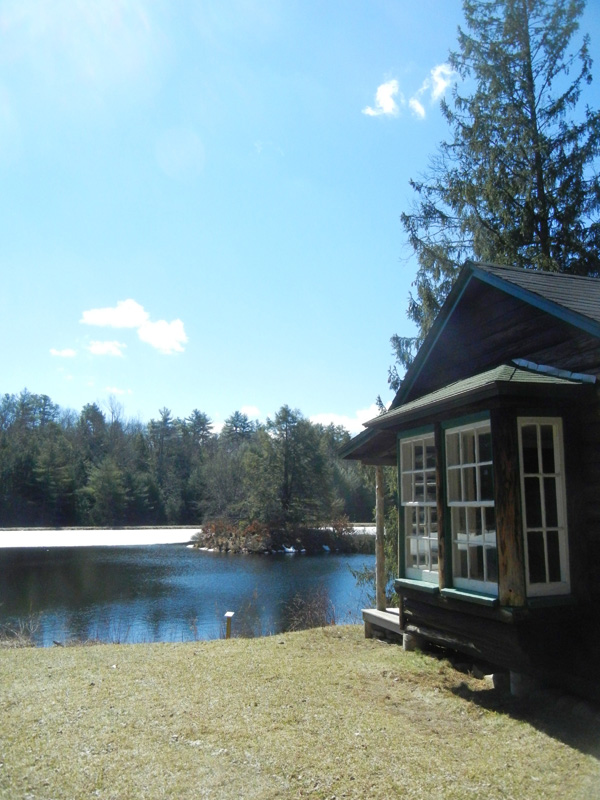
Senator McLean's cabin with a view of Trout Pond partially covered with ice.

After leaving the pond, I turned left on the loop back toward Salmon Brook Park.  In the lower muddy area between the game refuge and the park, I found some skunk cabbage in bloom.  Near the bridge, in a dryer, sandier spot, I saw some yellow flowers that I at first took for dandelions, but upon closer inspection, I believe they are coltsfoot.

Skunk cabbage.


Coltsfoot.


Sunday, February 24, 2013

Outdoor Hour - Birds


This month's Outdoor Hour Challenge has been Birds.  Most of our focused nature time was spent on owls (which I wrote about here), but we accomplished a few other miscellaneous bird-related activities, as well.

One of the first things we did was identify bird feathers.  A great source for identifying bird feathers is the U.S. Fish & Wildlife Service's Feather Atlas.  It contains pictures of flight and tail feathers of most common North American birds.  The Feather Atlas gives you the ability to identify a feather based upon its pattern and color, or if you think you know the bird that the feather is from, you can search on that bird.  I will tell you that there were a couple of feathers that we thought for sure we knew (It's yellow, it must be a goldfinch) and were completely wrong (No, it's a flicker)!


The other source we used for feather identification was the book Bird Feathers.  This book was helpful in that it included more than just flight and tail feathers.  Using this book, we were able to identify a body-feather of a ring-necked pheasant. 

Please note, that it is illegal to possess the feathers, nests, or eggs of over 80% of the birds found in the United States (Birds Protected by the Migratory Bird Treaty Act).  If you find a feather, I suggest taking a picture of it for later identification (and also make a note of the date and where you found it - something I neglected to do and would have found helpful).  Here is a summary of some of the key provisions of the Act.

We have also been participating in Project FeederWatch.  On Mondays and Tuesdays we record the birds that visit our feeders.  So far we have seen the following birds:
Dark-eyed Junco - Usually more than one and a sign that other birds are in the area.  They are most often under the feeders picking up seeds that the other birds have dropped, but occasionally I'll see them on the feeders, probably knocking food down to their friends.  They have a hard time balancing on some of the feeders.
Black-capped Chickadee - a favorite from my childhood.
Tufted Titmouse - they seem to be the least afraid.  The only ones that come to our window feeder.
White-breasted Nuthatch - the little acrobats, hanging onto the feeders with their heads below their tails.
Downy Woodpecker - we often see the male and female taking turns.
Red-bellied Woodpecker - the first time I saw this bird, I was just stunned by its red head.  I am always excited to see it at the feeder.
American Goldfinch - a little hard to identify in its winter colors

The following have been seen, but not on our FeederWatch days:
Mourning Dove - at first glance these birds seem rather plain, but upon closer inspection they are really quite pretty.
Carolina Wren - saw my first one a year or two ago.  We are at the northern end of its range.
Blue Jay - I've always thought of this bird as kind of a pest and it is so numerous here, I take it for granted.  It is funny that when we were out west and saw our first Steller's Jay, we thought it was so exotic!
Red-breasted Nuthatch  - this is a new one for us.  I saw a bird at the feeder that looked like a nuthatch, but something wasn't quite right.  It didn't seem big enough.  Then I noticed the eyestripe.  I took a quick look at the FeederWatch poster that we have hanging on the wall and there it was - Red-breasted Nuthatch.  Cool!  To be added to my bird life list.


Finally, I came across a book at the library about the Ivory-billed Woodpecker.  The book, The Race to Save the Lord God Bird was in the Children's book section, but I found it fascinating.  It starts with an account of the early days of ornithology, which seemed to revolve mostly around shooting specimens and then painting pictures of them.  Specimens continued to be collected even after it was evident that a species was in decline.  The heart of the book was the work done by Cornell and, in particular, Jim Tanner in photographing and recording the Ivory-bill.  Because the book was published in 2004, just before the claims of sightings in Arkansas came to light (after not having a documented sighting in the US since 1944),  I decided to watch the 2010 video, Ghost BirdThe video shows footage from Arkansas that some say shows an Ivory-billed Woodpecker in flight.  However, the video is contested by others, including famed ornithologist David Sibley, who have come to the conclusion that the bird in the video is something else, possible a Pileated Woodpecker.

I really hope that the bird still exists, but given the lack of sightings and the loss of habitat, it seems unlikely.  One of the positive aspects of the search for the Ivory-bill has been the preservation of habitat.  The drawbacks, which I had really not considered until reading and watching the video, are that millions of dollars are being spent to hopefully bring about the recovery of the species.  That means millions of dollars less for other, perhaps more viable, projects.  An interesting debate.


Thursday, February 21, 2013

Outdoor Hour - Owl Study

Last week, I watched as the weather reports showed two storm systems heading toward the northeast.  The meteorologists were predicting they would converge and the result would be a blizzard.  I knew that this likely meant that my older son, who is now in public school, would have a day off.  For us, a day off from public school means a day off from homeschool (just try and get the homeschooled one to work when the other one isn't)!

But, there are some homeschool activities that do not seem like work and I managed to slip those in on the snow day.  First, knowing that teenage boys like to eat, I suggested we make cupcakes that look like little owls.  (The idea came from an old  Family Fun Magazine.)  I baked the cupcakes the night before the storm.  My son made the icing and frosted all the cupcakes the day of the blizzard.  Then the two of us did the decorating.  Lots of silliness as we chose the color for the owl's eyes (the one on the bottom right looks a little zombie-ish).


Later that afternoon, we used the computer to watch a really fascinating show on PBS's Nature called Magic of the Snowy Owl (one sad part may upset little kids).  It was comical to watch the owlets as they first spread their wings - and landed on their face.  Those little guys ate a lot and kept their parents busy.  Initially, the mother had to give them small chunks of food, but it wasn't long before the babies were able to gobble down whole lemmings!  The parents' concern for their young was evident and very touching.  What magnificent birds!

This week, we dissected some owl pellets that were left over from our biology studies last year.  We used the bone chart and the rat skeleton to identify what we found.  It seemed like each pellet contained at least two rats/mice.  My son's pellet contained two easily identifiable skulls while mine contained one, but seemed to have many more mandible pieces and parts of pelvises.


After dissecting the pellets, we read the section in Owl Puke about how the pellets are actually formed.  We learned that owls have two stomachs. The first stomach has acids and enzymes that break down the food, and mucus that helps move everything including bones and fur into the second stomach.  The second stomach has powerful muscles that both grind up the meat and wad all the indigestible stuff into a pellet.  This pellet will then move back to the first stomach and be regurgitated.

To wrap up our owl study, we compared owl feathers with those of other birds.  Owls are unique in that they are able to fly silently.  The reason for this can be seen when looking at the edges of their feathers.  An owl feather is fringed along its edge.  (See this side-by-side comparison of an owl and a hawk feather.)  The fringes break up the turbulence over the wing and allow for silent flight.

I'm hoping we can find a Owl Prowl hike to join in the next month or two.  The barred owl mating season occurs over the next two months and is a good time to hear the signature "who cooks for you" call.

Oh, by the way, we got at least two feet of snow during the storm!


Outdoor Hour Challenge at Handbook of Nature Study.

Wednesday, January 30, 2013

Outdoor Hour - Rocks & Minerals


The weather this month has really not been conducive for getting out and looking at rocks.  We have had snow cover all month and the past week has been especially cold.  (Excuses, excuses!)

That did not mean we could not do some rock study though.  We got out our box of rock and mineral specimens.  Many were from a rock shop in Estes Park, Colorado that we visited several years ago.  I remember we had a great time looking at all the different rocks and choosing ones to take home with us.  This can't compare to digging for rocks yourself, but it does allow you to get a variety of rocks and minerals from around the world.  Thankfully, I had the brainstorm to take pictures of the rocks in the labeled containers in the store.  Our rock box was not at all organized or labeled, so without the pictures, we would have had a pretty hard time identifying them.  (Although, I think it would be a good test to try and identify them using a guide book or website and see how far we could get).  B went ahead and made identification cards for them and put them on display.


The other activity we did was to grow crystals.  We started with Epsom salt crystals.  We have grown Borax crystals in the past, but I liked the results of the Epsom salts better.  They grew more quickly and had a much more delicate look.


In the process of digging out our "rock box", we also found some crystal growing activities that I had probably bought as stocking stuffers, but had never used.  One kit came with some "magic" water and a little cardboard tree.  The tree sucks up the water and the crystals form on the branches.  Not as spectacular as hoped, but it probably has to do with the temperature and humidity level (lack of humidity right now) in our house.


In the box, we also found some Popcorn Rock.  This is a limestone rock that we put in a glass bowl, covered with distilled white vinegar and then waited for the vinegar to evaporate.  Aragonite crystals formed on the surface of the rock.  And here is our vocabulary word for the month: Polymorph.  We learned that Aragonite and Calcite are polymorphic, meaning that they have the same chemical composition (CaCO3 - Calcium Carbonate), but different structure.  (The best example of polymorphs may be graphite and diamonds. Both are made of carbon, but because of the different heat and pressure under which they form, they have different structures and different properties).


There is so much more to do, but we have run out of time this month!  We have just started getting into the Golden Guide to Rocks, Gems and Minerals.  For a little book, it packs a lot of information. We will be doing Earth Science next year, so I am sure we will continue our studies.

Wednesday, December 5, 2012

The Birds are Back!

Wow!  That didn't take them long.

My son and I went out at lunchtime today to hang up our bird feeders (we take them down in the Spring because of bears) and within an hour, the birds had found them and were having their lunch.

The Tufted Titmice found the feeders first followed by Black-capped Chickadees, White-breasted Nuthatches, a Red-bellied Woodpecker, and a Downy Woodpecker.  Seriously, all within an hour of putting them up!

Tufted Titmouse
White-breasted Nuthatch

Female Downy Woodpecker


Male Downy Woodpecker

Continued Mammal Study - Deer

The night I submitted my last Outdoor Hour post for our mammal study, my husband was awakened by a sound that he at first thought might be a squirrel running across the roof.  Then he decided maybe it was an animal scratching on a tree outside.  He went downstairs to see if he could figure out what it was.

What he saw in our neighbor's yard were two white-tailed deer bucks locking antlers!  He watched as they fought for a bit and then one ran off with the other in pursuit.  The next morning, he took us outside to see the signs they had left behind.

Markings from deer hooves on new pavement.

Area of neighbor's lawn dug up by fighting.
I know it is really hard to tell anything from the pictures, but it's all I have.

This event prompted some research on white-tailed deer.  We first read from the CT DEEP's wildlife fact sheets and then from the State of Wisconsin's Critter Corner page.

Here are a few interesting facts:
  • Deer are ungulates, meaning they have hooves.
  • White-tailed deer are the smallest deer in North America.
  • The underside of their tail is white and is raised as a flag when they leap away in alarm.
  • Their coat color varies with the season, a more red-brown in the summer and gray-brown in the winter.
  • The peak rutting or mating season in CT is the last two weeks in November.
  • Male deer, called bucks, grow a new set of antlers each year.  The antlers are covered with a soft tissue called velvet that they will rub off in the fall. While the antlers are still covered with velvet, they are very sensitive and the bucks will not use them to fight.  Instead, they will stand on their hind legs and use their forefeet.
  • The size of antlers depends on a couple of things, including maturity, but most significantly, nutrition.
  • The bucks use their antlers for sparring and they are usually shed from the middle of December to late January in CT.  Deer in more southerly states shed their antlers later.
  • Female deer, called does, depending on their diet and health, can have between one and four fawns at a time.


Seeing deer in our neighborhood is not that uncommon.  We have often seen several in the woody area behind our house, but I have never seen a buck.  Next time I hope my husband will wake me up!